When a child asks "Why?", how often can we encourage the question instead of giving a quick answer?
It is an important question for parents and educators in today’s age.
For generations, education often rewarded obedience.
Students followed instructions, memorised answers, and averted mistakes.
While discipline and respect remain important, the modern world demands something more.
Children now need to think independently, solve unfamiliar problems, and make thoughtful decisions.
This is why the conversation is shifting from raising obedient children to developing independent thinkers.
At Tapas Education in South Bangalore, learning is designed to encourage curiosity, questioning, exploration, and reflection.
Students are not simply taught what to think.
They are encouraged to understand how to think.
In this blog, you will understand:
Why independent thinking skills for students matter
The importance of critical thinking in education
Practical ways schools and parents can support independent thinking
How Tapas nurtures confident and thoughtful learners
Let’s explore what children truly need to thrive in today’s world.
What Does It Mean to Be an Independent Thinker?
An independent thinker evaluates information thoughtfully.
They do not simply accept ideas because someone tells them to.
Independent thinkers:
Ask questions
Consider different perspectives
Form their own opinions
Make informed decisions
These skills aid learning and life.
Why Independent Thinking Matters Today
The world changes rapidly.
Children face information, choices, and challenges every day.
Success increasingly depends on the ability to:
Analyse information
Solve problems
Adapt to change
Think creatively
These abilities cannot develop through memorisation alone.
The Difference Between Obedience and Independent Thinking
Obedience and independent thinking are not opposites.
Children can be respectful while also thinking for themselves.
Obedience Focus | Independent Thinking Focus |
Following instructions | Understanding reasons |
Seeking approval | Evaluating choices |
Avoiding mistakes | Learning from mistakes |
Memorising answers | Exploring possibilities |
Healthy education equalises both.
Importance of Critical Thinking in Education
The importance of critical thinking in education continues to grow.
Critical thinking boosts children to:
Question assumptions
Evaluate evidence
Solve complex problems
Make thoughtful decisions
These abilities support academic success and future careers.
They also help children become responsible citizens.
Independent Thinking Skills for Students
Several critical skills contribute to independent thinking.
1. Curiosity
Curious children naturally seek understanding.
Questions become opportunities for learning.
2. Problem-Solving
Children learn to survey solutions independently.
This builds confidence and resilience.
3. Reflection
Reflection encourages deeper understanding.
Students learn from experiences and errors.
4. Decision-Making
Children benefit from making age-appropriate choices.
Decision-making builds responsibility.
5. Open-Mindedness
Independent thinkers consider many different viewpoints.
They remain willing to learn and adapt.
How Schools Build Independent Thinkers
Schools play a major role in developing these abilities.
Inquiry-Based Learning
Students investigate questions rather than rote- learning answers.
Learning becomes active and engaging.
Project-Based Learning
Projects need students to:
Research
Analyse
Create
Present
This develops real-world thinking skills.
Classroom Discussions
Open discussions encourage students to express and defend ideas respectfully.
Communication and thinking grow together.
How Tapas Encourages Independent Thinking
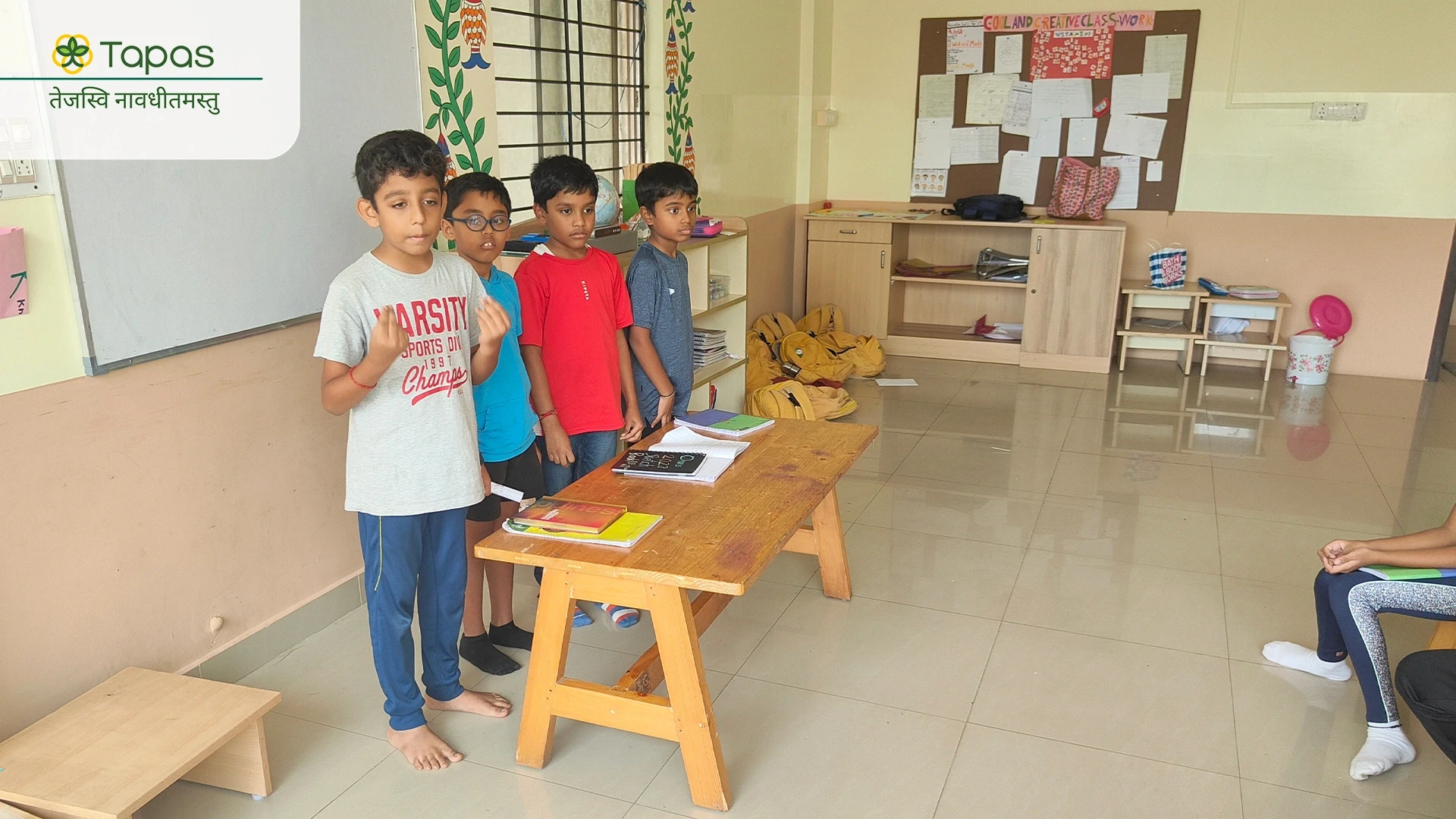
At Tapas Education, independent thinking is part of everyday learning.
Learning Practice | Student Experience | Outcome |
Inquiry Projects | Asking meaningful questions | Curiosity |
Collaborative Learning | Sharing perspectives | Open-mindedness |
Reflection Circles | Self-assessment | Self-awareness |
Real-World Projects | Problem-solving | Independence |
Students learn to explore rather than simply observe.
Real Classroom Example
Students once investigated local waste management practices.
They:
Collected information
Interviewed community members
Identified challenges
Proposed solutions
There was no single right answer.
Students learned how to think critically and independently.
How Parents Can Aid Independent Thinking
Parents can nurture these skills at home.
Ask More Questions
Instead of providing answers immediately, ask:
What do you think?
Why do you believe that?
What other possibilities exist?
Encourage Decision-Making
Let children make age-appropriate choices.
Small decisions build confidence.
Welcome Mistakes
Mistakes provide valuable learning opportunities.
Growth often comes through trial and error.
Listen Actively
Children develop confidence when their ideas are esteemed.
Conclusion
The future belongs to learners who can think, adapt, question, and solve problems independently.
This is why understanding how to raise independent thinkers in school is so important.
The goal is not to opt for between obedience and independence.
The goal is to develop thoughtful, responsible individuals who can make informed decisions.
At Tapas Education, students build the independent thinking skills for students that support lifelong success.
They learn not just what to learn, but how to think.
Looking for a school that encourages curiosity, confidence, and critical thinking?
Frequently Asked Questions
How to raise independent thinkers in school?
Schools can raise independent thinkers by encouraging curiosity, problem-solving, open discussions, and giving students opportunities to make informed decisions.Why are independent thinking skills for students important?
Independent thinking skills for students help them analyze information, solve problems creatively, make confident decisions, and become lifelong learners.What is the importance of critical thinking in education?
The importance of critical thinking in education lies in helping students evaluate ideas, ask meaningful questions, and apply knowledge to real-world situations.How do schools develop independent thinking skills for students?Schools develop independent thinking skills for students through project-based learning, collaborative activities, inquiry-based lessons, and reflective learning practices.
Why is the importance of critical thinking in education increasing today?
The importance of critical thinking in education is growing because it prepares students to adapt to change, solve complex challenges, and succeed in higher education and future careers.